The View from the Camera Obscura
The camera obscura makes a projected image visible on a wall or screen, revealing how viewpoint, light and framing shape what an observer can see.
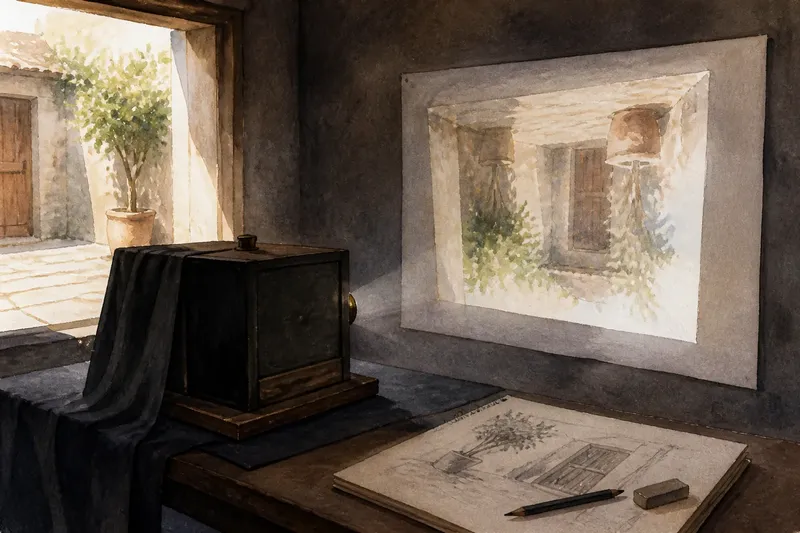
Imagine carrying a camera obscura into a dim room and watching the outside street appear, upside down, on a sheet of white paper. That projected view is the camera obscura in action: light travels through a small opening and forms an image on the opposite surface. Its appeal lies not only in the projection itself, but in the questions it poses about seeing, selecting and making pictures.
The following walk-through is invented. It follows an imaginary observer as she explores a courtyard with a portable dark box, then considers what the experience can teach us about the camera obscura and later habits of picture-making. Nothing in the scene is offered as a historical record; the point is to examine what the device makes visible.
What does the camera obscura show?
The name means “dark room”. In its simplest form, the camera obscura is an enclosed space with a small aperture, or opening, on one side. Light from the scene outside passes through that aperture and falls on the opposite wall or screen, where it produces an image.
Light travels in straight lines, so rays from different parts of the scene cross at the opening. Rays from the top of an object reach the lower part of the screen, while rays from its bottom reach higher up. The image therefore appears inverted, both vertically and horizontally. A lens can gather more light and produce a brighter, more defined projection, but the basic principle remains the same.
The device does not record the scene as a photograph does. It offers a temporary optical image that can be observed, traced or discussed. That distinction matters: the projection is an event of seeing, while a drawing or photograph is a made object that can be kept and revisited.
How does the imaginary courtyard become a viewing lesson?
Imagine Mara, an invented observer, setting a small, light-tight box on a stable table inside a shaded courtyard room. A tiny opening in one side faces a sunlit courtyard; across the interior, she places a sheet of white paper. She waits for her eyes to adjust, then looks at the paper rather than at the opening.
At first, the image is faint. Mara darkens the room by closing a door and covering a gap around the shutter with dark cloth. The courtyard projection becomes easier to distinguish: a doorway, a potted plant and a bright patch of paving appear upside down. She has not altered the courtyard. She has changed the conditions under which its light reaches her.
She notices that the opening admits only a portion of the scene. A slight turn of the box replaces part of the doorway with a wall; a small shift changes where the plant sits on the paper. The image makes viewpoint tangible. What seems like a simple view is already bounded by the position of the observer and the direction of the opening.
Next, Mara compares the projection with a quick pencil sketch. She turns her paper around to make the scene easier to copy, but the act of tracing still requires choices. She has to decide which edge belongs to the pot, where a shadow ends and whether the bright paving matters enough to include. The projected image supplies visual information; it does not decide what the drawing should say.
Finally, she moves the box nearer a bright patch of courtyard and then points it towards a darker corner. In the darker view, shapes become harder to separate. She learns that a projection depends on the contrast between light entering the aperture and the dimness inside the box. The room is not merely a container for the image; its darkness helps make the image legible.
What can the projection teach about observation?
Mara’s imagined session turns observation into a set of distinct decisions. The aperture limits the field of view, the box fixes a particular viewpoint, and the screen makes the arriving light available for close inspection. These constraints reveal that looking is not the same as taking in everything at once.
The projection also separates the scene from its appearance. A courtyard wall remains upright outside, yet its image appears inverted on the paper. The observer encounters a visual arrangement produced by light, not a miniature courtyard placed inside the box. This helps explain why seeing involves interpretation: the eye and mind make sense of patterns that arrive in a particular form.
There is a useful difference between noticing and deciding. Mara can notice that the plant’s leaves overlap the doorway, then decide whether to preserve that overlap in her sketch. She can observe a bright patch on the ground without treating it as the subject. The camera obscura gives her something to inspect, but the picture-maker still directs attention through selection.
How did this way of seeing inform picture-making?
Camera obscura devices belong to a long history of exploring how light forms images. Their projected views offered artists and observers a way to examine perspective, proportion and the appearance of a scene from a fixed position. Such projections could assist looking or drawing, but they were not a complete substitute for a maker’s judgement or skill.
The device also makes a helpful distinction between optical projection and a finished picture. A projection changes when the box moves, the light shifts or the observer alters the opening. A drawing can simplify, rearrange or emphasise features; a photograph fixes an image through a separate process of capture. The projected view may inform picture-making without dictating its final form.
Thinking about the camera obscura can therefore sharpen the way we read images. Ask where the imagined observer stands, what the frame excludes and how light separates one form from another. Those questions apply to a photograph or painting even when no camera obscura was involved. They treat composition as a set of visible choices rather than as a neutral copy of the world.
What questions do people ask about the camera obscura?
Why is the camera obscura image upside down?
Light rays from the top and bottom of the scene cross as they pass through the small opening. The top of the scene lands lower on the screen, and the bottom lands higher, producing an inverted projection.
Does a camera obscura need a lens?
No. A small aperture can form an image without a lens, though the projection may be dim or soft. A lens can gather more light and help produce a clearer image, depending on the arrangement.
Is a camera obscura the same as a camera?
The camera obscura projects an image into a dark space, but it does not inherently preserve that image. A camera records an image on a light-sensitive surface or sensor, so it can be stored and viewed later.
Can the projection tell an artist exactly what to draw?
No. It shows how light from a particular viewpoint falls on a screen, but an artist still chooses what to include, clarify or change. Tracing may transfer visible contours, yet the resulting picture reflects decisions about emphasis and interpretation.
What should a viewer take from the imagined scene?
Mara’s courtyard observation offers a compact lesson: an image depends on where the observer stands, what the opening admits and how the receiving surface presents the light. The camera obscura makes these conditions unusually easy to inspect because its projected view changes as the apparatus or illumination changes.
For a practical image-reading exercise, choose a photograph or drawing and imagine viewing its scene through a small aperture. Consider which features would remain inside that restricted view and which would fall beyond it. This thought experiment does not reveal the maker’s actual process, but it can help you see how framing and viewpoint guide attention.
The camera obscura is most useful as a way to think, not as a claim that pictures simply reproduce what the eye sees. Its dark interior turns passing light into something that can be studied; the observer then turns that study into a drawing, an explanation or a new question about the scene.